What is Lent? | The EPIC Ministry Podcast | Lent 2025


Lent is here! But what does it really mean? In this episode of The EPIC Ministry Podcast, a few of us break down the significance of Lent and discuss tips for making the most of this season. They cover the meaning behind Ash Wednesday, the spiritual power of sacrifice, and how fasting, prayer, and almsgiving help us grow closer to Christ. Topics Covered: -The significance of 40 in Lent -What is redemptive suffering? -The purpose of ashes -How should we approach Lenten obligations? -What are meaningful sacrifices for Lent? -How the body and soul are connected -Why the Church environment and liturgy change during Lent -Tips for a more intentional Lenten journey
Join us for this Lenten crash course and get practical insights to deepen your faith this season!

Cultural Insights - The Palaka Shirt

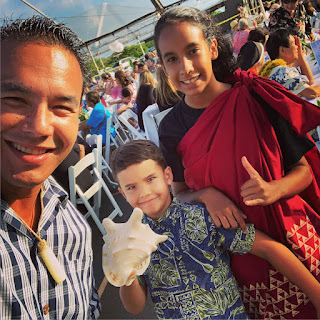
The palaka shirt is the one I am wearing on the far left
The palaka shirt, with its distinctive checkered pattern, has a rich history deeply intertwined with Hawaii's cultural and social fabric. Originating from the time of King Kamehameha the Great, the palaka pattern found its way to Hawaii in the late 1900s when Americans imported checkered-patterned cloth from England for field worker uniforms. Initially a design for English sailors, it was affordable due to its plainness. The Hawaiians and Issei (first-generation Japanese immigrants) named this pattern after the Hawaiian word for 'frock', which was a mistranslation for "checkered". This pattern became synonymous with the working class, especially during the plantation years between 1885 and 1941. Zempan Arakawa, recognizing the need for affordable clothing for workers, began producing long-sleeve work shirts, making palaka a staple in every Hawaiian's wardrobe. By the 1930s, palaka shirts were worn for various occasions, from school to parties, symbolizing its widespread acceptance and significance in Hawaiian society.

However, as time progressed, the palaka's dominance began to wane, especially during the Silver Screen years between 1945 and 1960. While palaka had its moments of popularity among tourists, it was the vibrant and colorful aloha shirt that began to captivate both locals and visitors. The aloha shirt's appeal was further amplified by Hollywood's portrayal of Hawaii, with movies promoting the "go Hawaiian" theme. The palaka, once the emblematic shirt of Hawaii, started to be overshadowed by the allure of the aloha shirt, which was seen as fresher and more comfortable due to its rayon fabric. Despite this, the palaka remained a symbol of local identity, especially during the 1960s to 1980s, when it became a sartorial emblem in local politics.

In recent years, the palaka's popularity has diminished, particularly with the closure of iconic palaka producers like Arakawa's in 1995. The decline in the quality and availability of the fabric, coupled with changing fashion trends, has made the palaka less prevalent. However, its significance in Hawaiian history cannot be understated. As Zempan Arakawa aptly put it, "palaka is more Hawaiian than the Hawaiian shirt." Today, while the palaka might not be as ubiquitous as it once was, its legacy as a symbol of Hawaii's unique culture and identity remains indelible. It stands as a testament to Hawaii's rich history, representing the islands' spirit of unity, resilience, and aloha. 

The Early Church On The Real Presence: EPIC Ministry Faith Sharing (6/12/23)


    Transubstantiation, a term coined during medieval scholasticism, refers to the belief that the substance of the bread and wine in the Eucharist changes into the substance of the body and blood of Christ, while the tangible aspects remain unchanged. This concept, also known as the doctrine of the real presence, was present in the Church from the beginning, as seen in the teachings of Jesus in John chapter 6 and the earliest Church Fathers. Although the term "transubstantiation" is not used in the Eastern Orthodox Church, they share the same belief, expressing it in their own terms. The doctrine is not a development in the Church; rather, the term itself took time to develop to explain the concept. 

    The Catholic Church uses Aristotle's philosophy in its doctrine of transubstantiation, the belief that during the Eucharist, the substance (the concrete entity) of the bread and wine change into the Body and Blood of Christ, while the accidents or appearances (akin to Aristotle's "essence") remain as bread and wine. This means that what is fundamentally the bread and wine (substance) transforms into the Body and Blood, despite retaining their original physical characteristics or essence (like taste, texture, and color). This application of Aristotle's ideas allowed for a philosophical explanation of a key theological mystery within the Catholic faith.

In this lecture we will cover the many sources of from the early church that give witness to belief in the Real Presence and will also layout a course of self-study for those that would like to study the Eucharist more in depth

Lecture Google Doc Resource - CLICK HERE

Audio Recording - CLICK HERE 

The 'AwaCast - Theology & Culture

Introducing the ʻAwacast! I will be using the Swellcast platform to upload weekly 3 - 5 minute short podcasts to share some Catholic thought, insights into the Hawaiian culture, and thoughts on my other avocations. Take a seat around the kanoa and let's inu a few apu while we share mo'olelo and engage in enriching conversations.

Ka Manuale Kakolilka - 1896 Hawaiian Roman Missal


I feel privileged to have come across a rare gem, a pdf of the 1896 "Ka Manuale Kakolilka," a Roman Missal created specifically for nā Kanaka 'Ōiwi and other speakers of ʻŌlelo Hawaii during that time. It offers a fascinating glimpse into the Catholic worship practices of the Hawaiian people in 1896, and is a treasure trove of Hawaiian translations of important Catholic prayers, including the Our Father, Hail Mary, the Creed, the Act of Contrition, and many other prayers.

Over the next few weeks, I plan to share some of these specific prayers for anyone interested in learning more. I will start with "Pule Ala" (Prayer upon waking) and "Pule Hiamoe" (Prayer before sleeping), I hope these translations will provide insight into the rich cultural and spiritual Catholic heritage of Hawaii's people.

Pule Ala

"E kuu Akua, aia no au imua o kou alo, ke haawi aku nei au ia oe i koʻu naau a pau. E malama mai oe iaʻu keia la, o lilo aku au i ka diabolo"

(My God, here I am before you, giving you all of my heart. Please take care of me today, so I don't become a devil)

Pule Hiamoe

"E kuu Akua, e hoomakai mai oe i koʻu hiamoe ana keia po. E hoopakele mai oe iaʻu i na hoowalewale ma o ka diabolo a me ka poe hewa"

(My God, please bless my sleep tonight. Deliver me from the snares of the devil and wicked people.)

ACCE 2023 - The Holy Eucharist "Behold, I make all things new" (Resources from presentation)


Resources shared during the presentation

• Diocesan Resource Page - https://bit.ly/revivaldr
• Formed.org - https://formed.org/
• Aleteia - https://aleteia.org/
• Magis Center - https://www.magiscenter.com/
• Franciscan University Institute - https://franciscanathome.com/
• Vietnamese Eucharistic Youth Movement - https://veym.net/
• Knights of Columbus - https://www.kofc.org/en/index.html
• Hallow - https://hallow.com/


Advent Traditions! The Ember Days, the O Antiphons, St Nicholas, St Lucy, & St Barbara

As we enter this beautiful liturgical season I wanted to share some videos I have made throughout the years about wonderful Advent traditions that have been much forgotten

A concise explanation of the ʻEmber Daysʻ Can be found in Theinʻs Ecclesiastical Dictionary: 

They are "the first Wednesday, Friday, and Saturday of each of the four seasons of the year, set apart as fast days by the Catholic Church. According to the testimony of Pope Leo, they originated in the time of the Apostles, who were inspired by the Holy Ghost to dedicate each season of the year to God by a few days of penance; or, as it were, to pay three days’ interest, every three months, on the graces received from God. The Church always commanded the Faithful to fast at the beginning of each of the four seasons of the year, because it is at this time that she ordains the priests and other servants of the Church, which even the Apostles did with much prayer and fasting." (Thein, J., 1900. Ecclesiastical Dictionary)

A much deeper look at the Ember Days, including a more detailed look at its historical roots, can be found in a great article by Michael P. Foley called ʻThe Glow of the Ember DaysʻYou can read it here - http://rorate-caeli.blogspot.com/2008/09/glow-of-ember-days.html 

Also during Advent is when the the Church prays the Advent O Antiphons. Here is a brief lesson I made for my students about this wonderful Tradition


In addition to those beautiful traditions there are also many other traditions that have been practiced by the Church throughout the ages like celebrating the feasts of 


Lā Kū‘oko‘a (Hawaiian Independence Day)

Hau'oli Lā Kū‘oko‘a! A hiki i ke aloha 'āina hope loa!

November 28th, Lā Kūʻokoʻa, is a Hawaiian Kingdom holiday that was first celebrated in 1843 to celebrate Hawaiʻi’s sovereignty and independence. This special day recognizes the signing of the Anglo-Franco proclamation acknowledging Hawaiʻi’s independence.


To learn more about this enormously important day in Hawaiian History please read this excellent article by Dr. Ronald Clayton Williams - https://bit.ly/lakuokoaaina

The Wind & The Reckoning

Movie to Movement, (https://www.movietomovement.com/) recently graciously sponsored EPIC Ministry with the opportunity to watch a brand new film titled 'The Wind & The Reckoning' starring Jason Scott Lee, Lindsay Watson,  Henry Ian Cusick, & Kahiau Perreira. It is a Hawaiian Kingdom Era movie and is 80% in the Hawaiian language. The IMDB summary is as follows - 1893. The Hawaiian Kingdom has been overthrown by a Western power just as an outbreak of leprosy engulfs the tropical paradise. The new government orders all Native Hawaiians suspected of having the foreign disease banished permanently to a remote colony on the island of Moloka'i that is known as 'the island of the living grave'. When a local cowboy named Ko’olau and his young son Kalei contract the dreaded disease, they refuse to allow their family to be separated, sparking an armed clash with brutal white island authorities that will make Ko’olau and his wife, Pi’ilani heroes for the ages.

Here is a trailer for the movie


Here is my brief video review of this excellent film


What an amazing movie. Chicken skin to hear our language used so beautifully through out the movie. The movie gives great respect to the Hawaiian culture and to the language. I truly hope this is the beginning of many more Hawaiian movies. So many stories to tell, so many great lessons to be learned

From this movie, besides bravery and perseverance, the biggest lessoned demonstrated is the immense power of the sacrament of marriage. Ko'olau and Pi'ilani truly understood the indissolubility of the bond they made before God and it was that loving bond that kept them together until the very end.

For more information about the film please visit - https://www.windandreckoning.com/

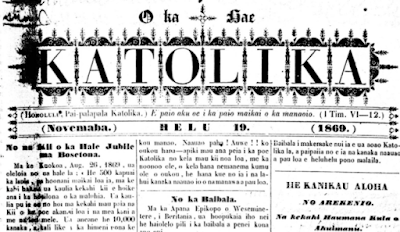
Discovering O Ka Hae Katolika


On the rare occasion of having 'free time' I enjoy reading and translating old Hawaiian kingdom newspapers. Up until the fairly recent digitization of thousands of pages of Hawaiian newspapers, the historiography of Hawaii had been relegated to just a handful of English sources. The translation of these newspapers over the last several decades has revealed a multitude of 'voices', written in the Hawaiian language, which share a very different view of what many of us locals understand as our history. It is always exciting to step into the past to learn how our ancestors thought and how they viewed the developing world around them.


On one such occasion I stumbled upon a Hawaiian Catholic publication from the late 1860s called O Ka Hae Katolika (The Catholic Standard) It was published from 1868 - 1871 by the Pai-palapala Katolika (Catholic Printing Press) This was during the historical period in which Bishop Louis D. Maigret, the Vicar Apostolic of Sandwich Islands at the time, was working hard to evangelize the kanaka maoli (native Hawaiians) and other Hawaiian subjects in the decades following Kauikeaouli Kamehameha IIIʻs edict of religious toleration. This was also the historical period in which the 'Ahahui Hoopuka Nūpepa Kūikawā o Honolulu', a group of independent newspapers founded by native Hawaiians, was actively working to give a uniquely Hawaiian voice to political groups and faith communities. The O Ka Hae Katolika clearly expressed that native Hawaiian Catholics were very proud of being Catholic and were also very proud of being Hawaiian. This newspaper gave them the opportunity to share Catholic news, stories, and insights from a uniquely Hawaiian cosmology as opposed to only reading Catholic news published by foreign presses.


Each issue of the O Ka Hae Katolika is filled with news from the Catholic church around the globe, commentaries on Scripture and church teaching,  stories of the saints, local happenings of the Church here in Hawaii,  stories of beloved local priests, and even letters from Bishop Maigret. In addition, and of very unique interest, some of the issues published mele (songs) and oli (chants) written in honor of some of the beloved priests that brought the Catholic Faith to Hawaii and lived their lives in service to those entrusted to their care.


The tagline to the O Ka Hae Katolika is "A paio aku oe ie ka paio maikai o ka manaoio" which means to "Fight the good fight of faith" – a bold call to mission as relevant today as it was one hundred-fifty years ago.

Ka uhi hou

Here is a video clip from the uhi (traditional Hawaiian tattoo) I received from Kawika Au. There is a lot of familial and experiential symbolism in the uhi. I will explain the symbolism one day. There are many layers to it. For now I just wanted to share the video

Island Wisdom & The Eternal Truth of Christ


I was honored to be able to write an article for the Catechetical Review at Franciscan University on my experience growing up as a Hawaiian Catholic and the great lessons I learned from my culture that helped me embrace my Catholic Faith

KofC - Faith Lecture Series Acrhive

 For 2021 and 2022 the Hawaii KofC decided to embark on a lecture series on Catholic Apologetics. In Holy Scripture we are called to "always be prepared to make a defense to any one who calls you to account for the hope that is in you" The word ʻdefenseʻ in that passage comes from the Greek ʻapologiaʻ. This is where we get the concept of biblical apologetics.  In our world today we as Catholics are often challenged on the tenets of our Faith. Whether it be our belief in the Real Presence of Christ in the Holy Eucharist, our belief in Purgatory, our practice of the veneration of the saints, or our clear and uncompromising positions on issues like abortion, euthanasia, same-sex marriage, etc it is essential to understand why we ,as Catholics, hold these beliefs and also the best ways to explain our Catholic beliefs to those that ask us "to account for the hope that is in you" Click on the picture above to be brought the the Hawaii KofC Archive of all the Faith Lecture Series events.

Father Christopher Keahi, ss.cc.

Please pray for the repose of the soul of Fr. Chris Keahi, ss.cc. He passed away early this morning. Fr. Keahi provided for the pastoral needs of many in EPIC Ministry and his parishes over the years. He also lovingly served the TLM community at Blessed Sacrament.

On a personal note he was hugely influential in the lives of my children. My boys grew to love altar serving because of his encouragement. He will be missed my family and by a large number of folks in our diocese.

Eternal rest grant unto him, O Lord and let perpetual light shine upon him. ... May his soul and the souls of all the faithful departed, through the mercy of God, rest in peace.


Temporal Punishment, Indulgences, & All Souls

Indulgences are one of the most misunderstood and unappreciated parts of our Catholic Tradition. In this lesson I discuss temporal punishment due to sin, Indulgences, and the grant given Catholics by the Vatican this year, 2020, to gain indulgences for the faithful departed during the month of November. If you would like a simple guide on how to gain indulgences, please see THIS SHORT ARTICLE I wrote several years ago on the topic

Ka Lu’au Ku (Lu'au Stew)

 Ua kuke au i ka lū’au kū me nā lau mai ke kīhapai. Ono loa!

Working Towards Food Self Sustainability

Our Aquaponic system at home is progressing well. Got okra, green onion, tomato, lettuce, kalo, spinach, bitter melon, and bok choy growing right now. I want to try watercress next. Mahalo e Ke Akua!

The Process of Beatification & Canonization: Anticipating Blessed Father Mcgivney

As part of the State of Hawaii Faith Program for the Knights of Columbus for 2020 - 2021 we have launched a Faith Lecture Series. The topic for the first session held on Tuesday 9/15/2020 was the Process of Beatification and Canonization: Anticipating Blessed Father Mcgivney. Here is the recording of the lecture

Interview on AOC, Father Damien, and Queen Lili'uokalani (The Jason Jones Show)

In the wake of the backlash that AOC received for her comments about St. Damien of Molokai, I joined the Jason Jones Show to discuss the legacy of Father Damien and how much the Hawaiian people loved him. Please consider subscribing to the Jason Jones Show. He is a great Catholic man that has committed his life to serving the vulnerable and fighting for those that have no one to fight for them

Click Here for the Interview